What budget would make Denmark's North Sea South investable?
Denmark’s latest offshore wind auction cleared, and the bidder interest behind it split along budget lines. Hesselø drew five bids. North Sea Middle drew two, despite the stronger site conditions. The third site, North Sea South, is still open, and on its current budget it is the one that looks hardest to finance.
Political parties have now started discussing an increase in the support available to it. So the question is no longer whether the budget is tight. It is how much more would be needed.
What is on the table at North Sea South?
North Sea South remains open for bidding until October 2028, which makes it the last of the three sites in this framework still to be awarded. The support budget attached to it is DKK 6.6bn, about EUR 885m.
That budget is the constraint. It sets the ceiling on what the state will pay out over the life of the contract, and therefore the ceiling on what a bidder can build a case around.
Why did Hesselø draw five bids and North Sea Middle two?
The two sites that have been awarded already showed what budget headroom does to bidder behavior. Hesselø, with the weaker site conditions of the two, drew five bids. North Sea Middle, with the stronger conditions, drew two.
That is the wrong way round if site quality were the only thing being priced. It is the right way round if what bidders were actually pricing was the relationship between each site’s budget and its cost base.
This matters for reading North Sea South, because it shows how a thin budget presents itself. Not as a failed auction, and not as a public complaint. It presents itself as bidders who do not turn up. Denmark has already seen the extreme version of that: The 2024 zero-subsidy round drew no bids at all, which is what prompted the move to a two-sided contract for difference in the first place.
Why is the current budget a problem?
Two things, and they are separate.
The first is returns. On the current budget, the business case does not produce credible returns for a bidder pricing the site honestly.
The second is risk, and it is the one that gets less attention. A support budget that only just reaches a viable return leaves nothing over for the residual risks that are still outstanding at bid submission. Those risks do not disappear because the budget is tight. They get carried by whoever bids, and a bidder with no margin to absorb them either prices them in, which pushes the required budget up again, or declines to bid.
There is also a symmetry worth noting on the state’s side of this. The reason an increase is being discussed at all is that the anticipated budgetary need for Hesselø and North Sea Middle came in lower than expected, because the strike prices cleared low. A lower-than-expected outlay on two sites and a shortfall on the third are the same fact seen from two ends of the same ledger.
How much more support would an 8% IRR need?
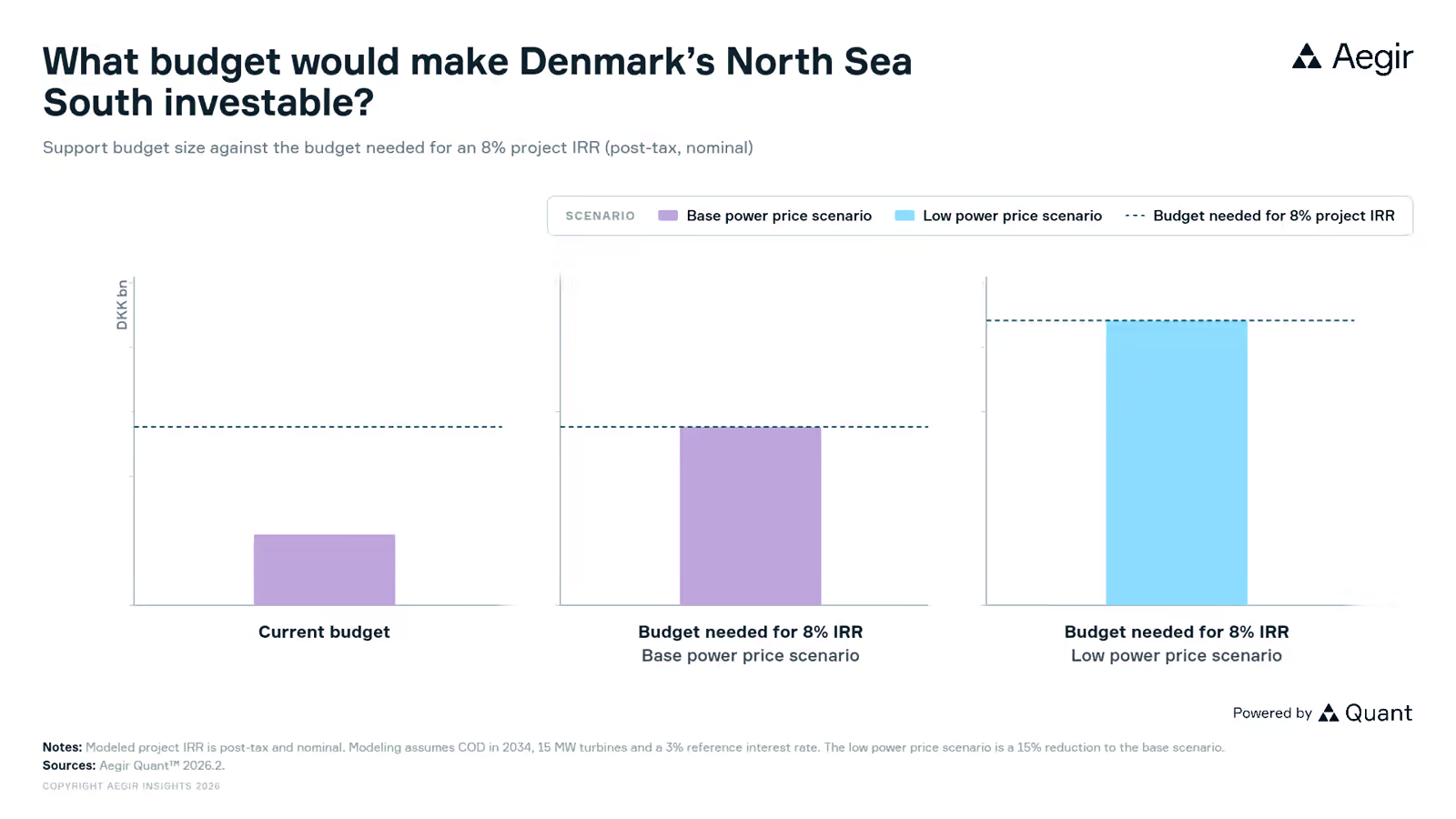
In Aegir Insights’ new analysis, we used Aegir Quant™ to model the budget increase North Sea South would need to reach an 8% project IRR, post-tax and nominal, under two power price scenarios.
An 8% post-tax nominal project IRR is a threshold, not a forecast. It is the hurdle the budget has to clear for the site to be investable at all, which means the useful output of the model is not the return, it is the gap between the budget that exists and the budget that would clear it.
The gap widens under lower power prices. A two-sided contract for difference does not insulate a project from the power price entirely, so the required budget is higher in the base scenario than the DKK 6.6bn on offer, and higher again in the low power price scenario.
The assumptions are held constant across both runs. Commercial operation in 2034, 15 MW turbines, and a 3% reference interest rate, with the low power price scenario set 15% below the base. Modeled in Aegir Quant™ 2026.2.
The scenario levels themselves, and the size of the increase each one implies, are in the insight.
Where to read the full analysis
Aegir Platform users can read the full Insight on the Aegir Intelligence Platform, including the required budget in each scenario and the return the current budget actually delivers.
The Danish sites, their lease areas and their owners sit in the Aegir renewables project database, alongside the rest of offshore wind globally. For how the first two sites were awarded, see our analysis of Denmark’s offshore wind auction results. North Sea South also sits in our global wind auction calendar as one of the rounds still open for bidding.
Want a walk-through of the analysis, including the Aegir Quant™ runs behind the budget scenarios? Reach out to us here.
Key questions on Denmark’s North Sea South support budget
What is the current support budget for North Sea South?
DKK 6.6bn, about EUR 885m.
When does bidding close?
October 2028. It is the last of the three sites in this framework still open.
Why is an increase being discussed?
Because the current budget does not support credible returns or leave any margin for the residual risks a bidder still carries, and because the anticipated budgetary need for Hesselø and North Sea Middle came in lower than expected after low strike prices.
How many bids did the two awarded sites draw?
Five for Hesselø and two for North Sea Middle, despite North Sea Middle’s stronger site conditions.
What return threshold did Aegir model against?
An 8% project IRR, post-tax and nominal, under a base and a low power price scenario.
What assumptions sit behind the modeling?
Commercial operation in 2034, 15 MW turbines, and a 3% reference interest rate, with the low power price scenario 15% below the base. Modeled in Aegir Quant™ 2026.2.