Floating offshore wind status: The projects defining the decade
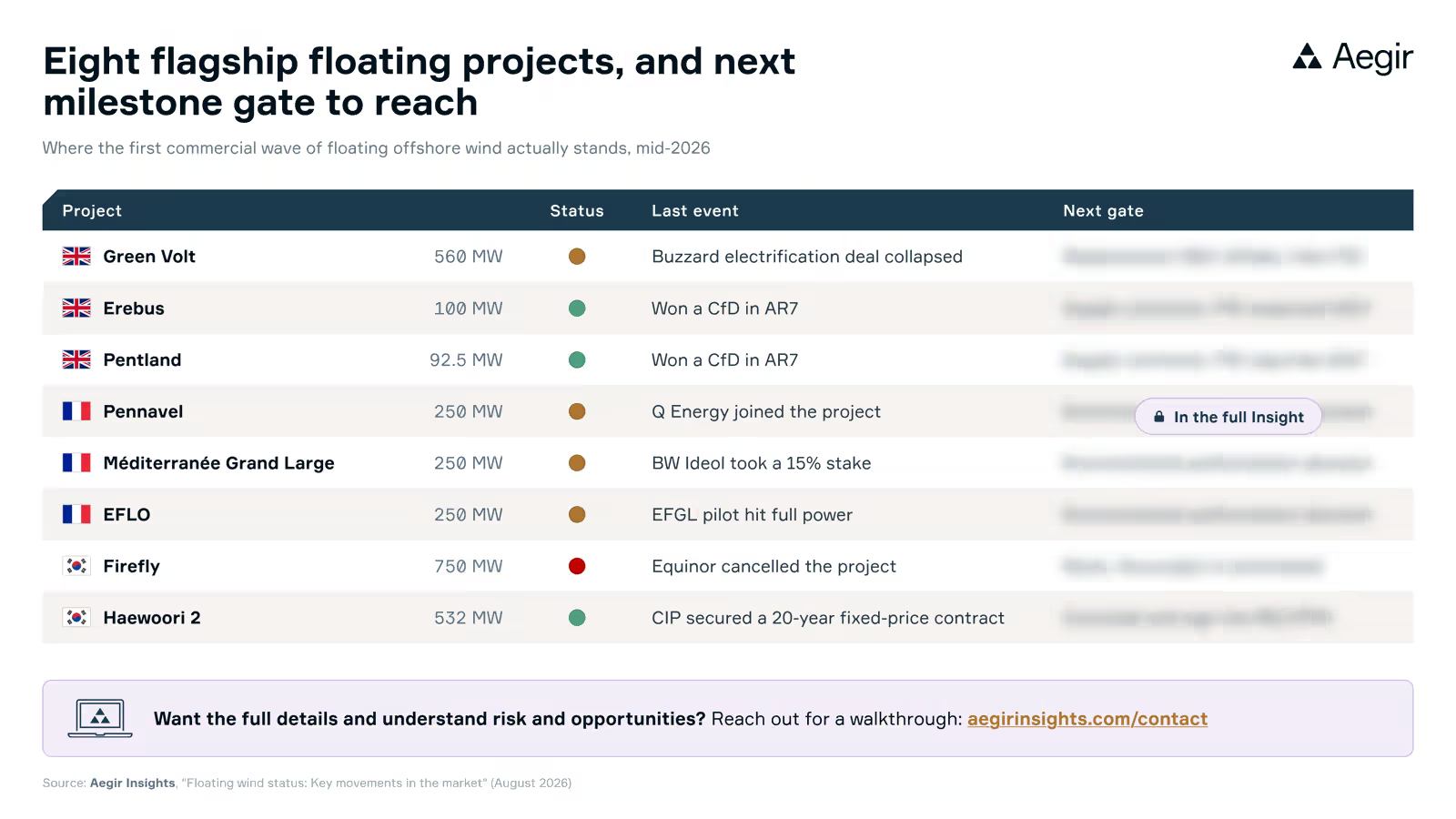
Mid-2026 has been an eventful stretch for floating offshore wind, in both directions at once. Demonstrator projects in France, Spain and China each cleared a technical or regulatory milestone. Over the same few months, first-of-a-kind commercial projects in the UK and South Korea ran into offtake, permitting and sourcing friction. The pilots are proving the technology. The commercial projects are the ones that have to prove the business case, and that is where the schedule is slipping.
What went right for floating wind in mid-2026?
Three demonstrator milestones landed inside a few months.
France: The 30 MW EFGL reached full power in July.
Spain: Two environmental impact assessments were approved at PLOCAN in a single month.
China: The country's first 16 MW TLP floater reached commercial operation.
None of these are commercial-scale projects, and none of them change the build-out forecast on their own. What they do is retire technical risk: A floater concept that has run at full power, and a test site clearing consents at pace, are the evidence base the next tier of projects gets financed against.
Which commercial floating offshore wind projects hit trouble?
Two first-of-a-kind commercial projects absorbed setbacks in the same window.
Firefly (750 MW, South Korea): Equinor cancelled the project in May 2026.
Green Volt (560 MW, UK): Fully consented and holding a 15-year CfD, the project is still several hurdles short of a final investment decision after the Buzzard electrification deal collapsed.
The pattern worth noticing: These are contractual and regulatory failures, not engineering ones. An offtake agreement that did not get signed, an electrification counterparty that walked, permits and supply contracts still open. Nothing on this list is a floater that did not work.
Where does the rest of the commercial fleet stand?
Eight projects make up the first commercial wave, and they are not moving at one speed.
| Project | Capacity | Last event |
|---|---|---|
| Green Volt (UK) | 560 MW | Buzzard electrification deal collapsed |
| Erebus (UK) | 100 MW | Won a CfD in AR7 |
| Pentland (UK) | 92.5 MW | Won a CfD in AR7 |
| Pennavel (France) | 250 MW | Q Energy joined the project |
| Méditerranée Grand Large (France) | 250 MW | BW Ideol took a 15% stake |
| EFLO (France) | 250 MW | EFGL pilot hit full power |
| Firefly (South Korea) | 750 MW | Equinor cancelled the project |
| Haewoori 2 (South Korea) | 532 MW | CIP secured a 20-year fixed-price contract |
Two of the eight have a route to market secured through the UK's AR7 round. Three French projects are still in permitting. One is cancelled. One has an offtake contract in South Korea. Each of them has a specific next gate to clear, and those gates are what the full Aegir insight sets out project by project.
What could hinder floating wind from here?
Two forces are working against floating, and neither is technical.
Governments will fund the cheapest gigawatt first. Where floating competes against fixed-bottom under a single budget or a single target price, the more expensive technology sits closer to the cut line. Support schemes that are technology-neutral by design are not neutral in effect.
Deepwater fixed foundations are moving into floating's water depths. Fixed-bottom-style structures reaching further offshore erode the depth range floating was expected to own outright. We looked at what that category actually amounts to in the UK in other deep water: Empty policy or real potential?
What decides which of these projects moves next?
Every project in the table has one specific next gate in front of it: A signature, a consent, or a supply contract. Those gates, rather than anything technical, are what will decide which of the eight moves and which stalls. We set them out project by project, with the detail behind both headwinds, in the full insight on the Aegir platform.
The projects and their gates are tracked in the Aegir renewables project database, which holds fixed-bottom and floating offshore wind side by side. That is the comparison the second headwind turns on, and it is the one most floating-only datasets cannot make. If you want it walked through for a specific project or market, get in touch.
Key questions on commercial floating offshore wind
Is floating offshore wind still progressing in 2026?
Yes, but unevenly. Demonstrator projects in France, Spain and China all cleared milestones in mid-2026, while first-of-a-kind commercial projects in the UK and South Korea ran into offtake, permitting and sourcing friction.
Why did Equinor cancel Firefly?
Equinor cancelled the 750 MW South Korean project in May 2026. It was the largest project in the commercial floating set.
Has Green Volt reached FID?
No. The 560 MW project is fully consented and holds a 15-year CfD, but still faces several hurdles before a final investment decision, after the Buzzard electrification deal collapsed.
Which floating projects have secured a route to market?
Erebus (100 MW) and Pentland (92.5 MW) won CfDs in the UK's AR7 round, and Haewoori 2 (532 MW) secured a 20-year fixed-price contract in South Korea.
What is the biggest risk to floating wind's momentum?
Cost position rather than technology. Governments funding the cheapest gigawatt first, and deepwater fixed foundations reaching into the water depths floating expected to own.