Best demand, worst policy: US onshore wind enters the post-credit market
Best demand, worst policy: US onshore wind enters the post-tax credit market.
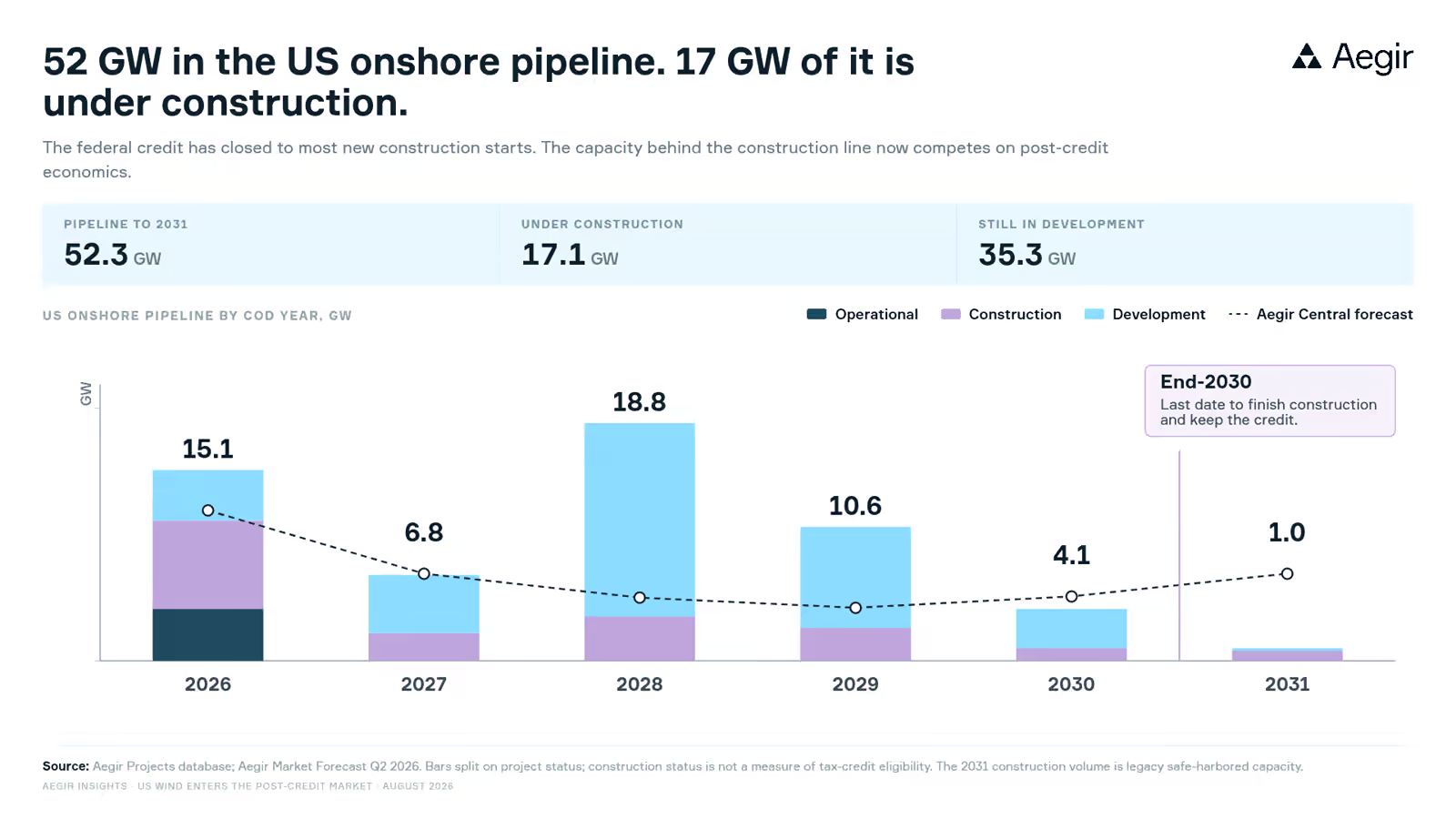
The US onshore wind development pipeline to 2031 sits at around 52 GW, of which only around 17 GW is currently under construction.
And most of the rest will enter a post-tax credit market.
Federal reviews have been unblocked, with a court ruling on 6 August restarting national-security reviews for more than 100 wind projects. But that ruling came a month after the construction-start deadline that closed the clean-electricity production tax credit to most new onshore wind projects.
Projects beginning construction now, after 4 July 2026, generally need to be in service by end-2027 to still qualify for the tax credits, a difficult timetable for most utility-scale projects. Projects that started earlier need to be in service by end-2030 to rely on the four-year continuity safe harbor.
At the same time, electricity demand in the US is rising much faster than firm supply. Large-load requests, particularly from data centers, are expanding rapidly, and the generation response so far has been dominated by gas proposals. But queue-advanced wind carries added value for buyers who need power sooner.
In our new analysis, Aegir Insights maps the US onshore wind pipeline with a 2026–2031 COD, benchmarks post-credit LCoE against the gas options and looks at the volume hanging in the balance that needs to find alternate routes to market now that the tax credits have largely run out.
Request trial access to read the analysis: www.aegirinsights.com/trial-request