
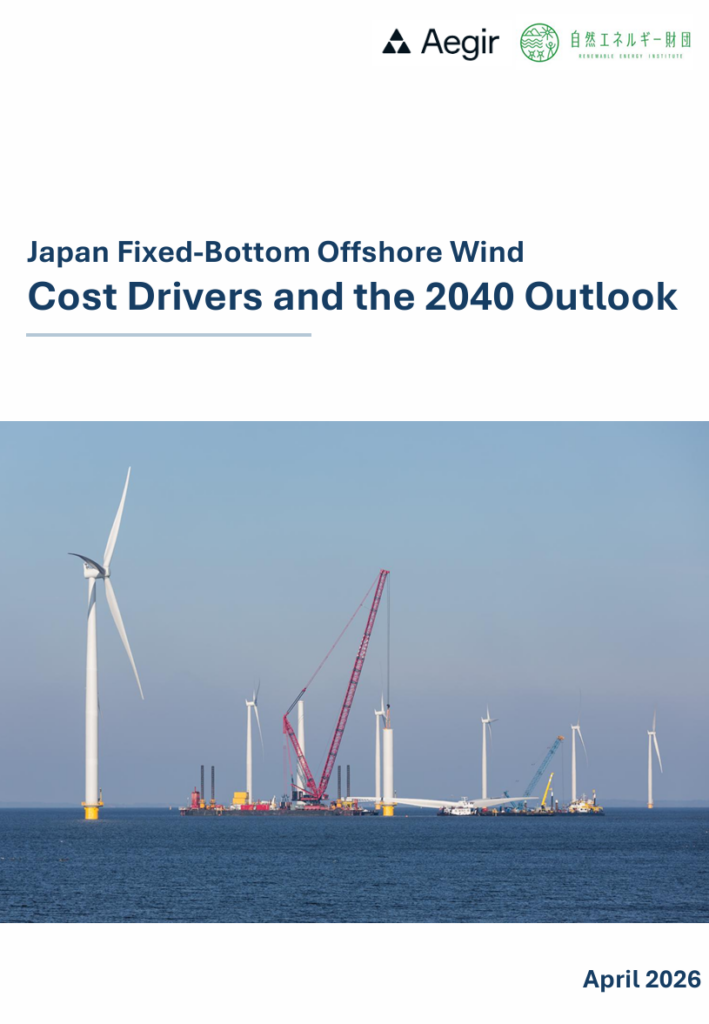
The Renewable Energy Institute / 自然エネルギー財団 in Japan and Aegir Insights have jointly released the report "Japan Fixed-Bottom Offshore Wind Cost Drivers and the 2040 Outlook”.
This analysis was produced as an independent research initiative and examines how Japan can accelerate the deployment of fixed-bottom offshore wind by identifying current cost drivers compared to Europe and exploring pathways for cost reduction through 2040. Using the Aegir Quant™ techno-economic model we benchmark Japanese CAPEX against a European reference case.
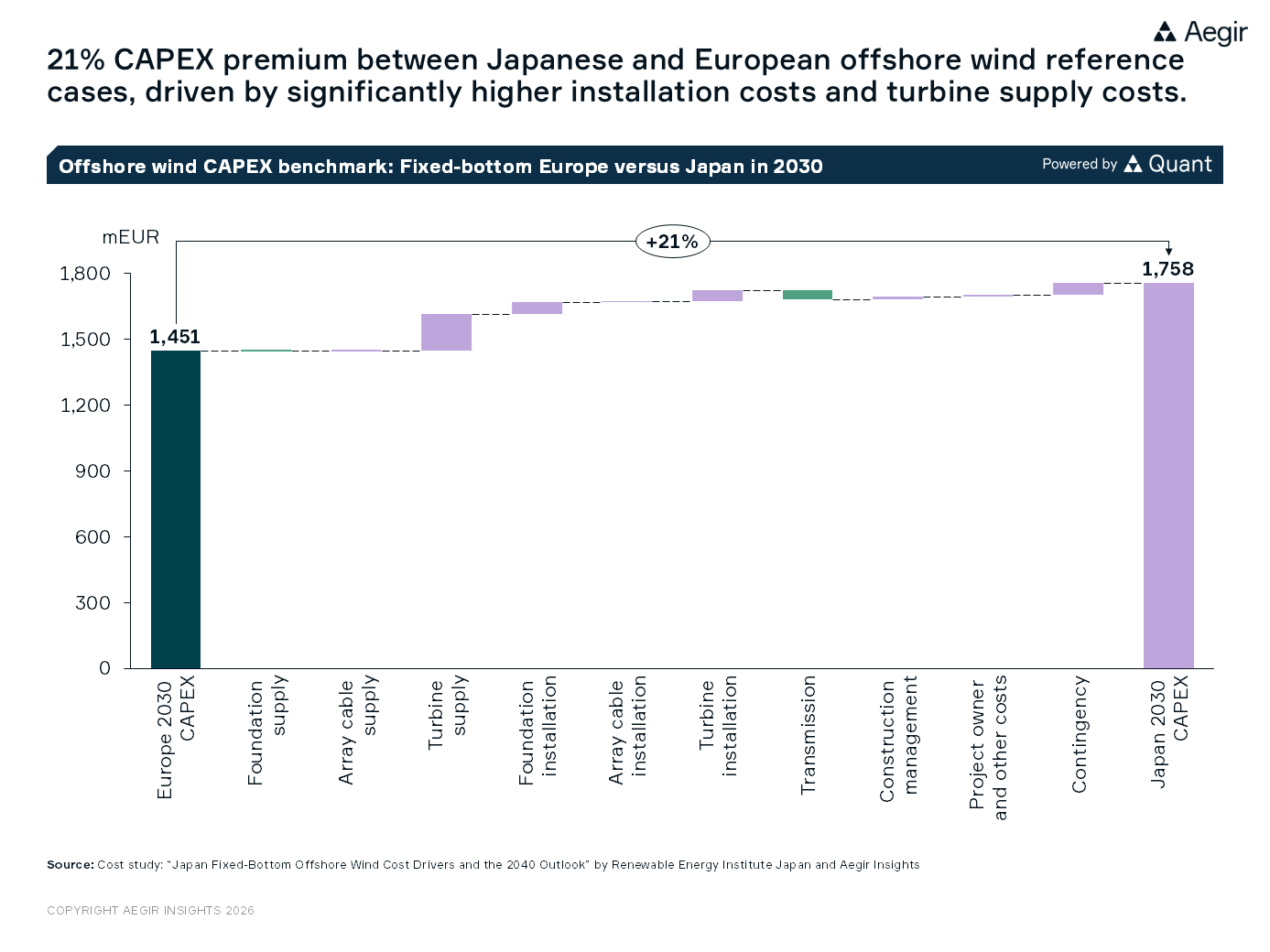
🔹 The central finding: a 21% CAPEX premium in 2030 in Japan compared to Europe, roughly three quarters of it driven by physical conditions like typhoons, earthquakes, and seabed geology, while the rest is addressable through market maturity and policy design.
🔹 By 2040, CAPEX per MW could decline by around 18% in Japan, led by turbine upscaling, better vessel availability, and market maturation, but a structural premium over Europe will likely persist.
🔹 The report sets out four priority areas for Japan's offshore wind market: commissioning-based pipeline targets with stable auction cadence, frameworks that can absorb post-auction economic shocks, a review of grid cost allocation, and addressing cabotage and port land-use constraints.
About REI: Renewable Energy Institute / 自然エネルギー財団 is a non-profit think tank which was established in August 2011, in the aftermath of the Fukushima Daiichi Nuclear Power Plant accident. It aims to build a safe and secure society based on renewable energy, along with a sustainable energy system and economy that mitigates climate change.
Aegir Newsletter: Stay up-to-date with development in renewable energy and new analysis by Aegir Insights
Delivered straight to your inbox, Aegir Insights' intelligence newsletter will sharpen your market insight with exclusive analysis on key markets, developments, and technologies shaping onshore wind, offshore wind and storage/hybrids.