US offshore wind stop-work orders reversed: Courts push back across all projects under construction
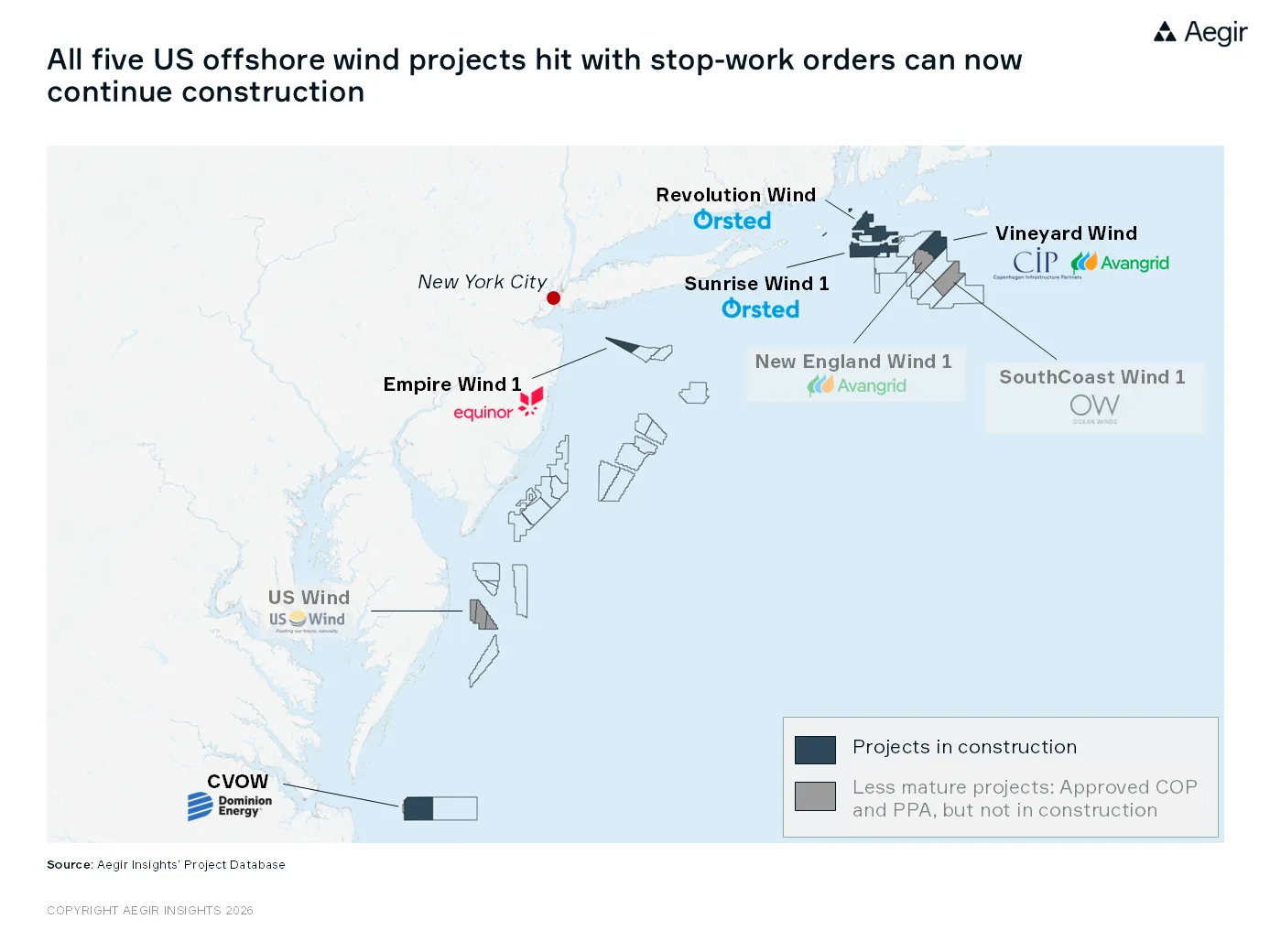
Over the past year, the US offshore wind sector has been subjected to a globally unusual level of politically motivated uncertainty – but the Trump administration’s decision to issue stop-work orders against all American offshore wind projects under construction on December 22nd 2025 marked a sharp escalation of his ongoing and infamous war on wind.
Almost immediately, all five affected projects challenged their stop-work orders in court and asked the judges to grant immediate judicial relief by issuing preliminary injunctions and/or staying the stop-work orders while the underlying court case runs its course.
With Sunrise Wind securing a favorable ruling on 2 February 2026, all five projects have now successfully obtained judicial relief and construction of the five projects continues.
Taken together, the rulings represent a consistent and clear rejection of the administration’s reasoning for stopping construction and create a strong foundation for immediate lawsuits in case the Trump administration attacks again.
Five projects, five stop-work orders, all based on the same argument
The stop-work orders targeted Revolution Wind, Empire Wind 1, Vineyard Wind 1, Coastal Virginia Offshore Wind (CVOW), and Sunrise Wind. In total, these projects represent the entirety of the US offshore wind capacity currently under construction.
Notably, Revolution Wind and Empire Wind were both hit by stop-work orders twice, underlining the persistence of the administration’s efforts to halt offshore wind construction.
While Empire Wind got its first stop-work order lifted through diplomacy, Revolution Wind was the first to take a stop-work order to court, as it sued the administration over its first stop-work order in September. The global wind industry watched with bated breath, and relief was palpable when judge Royce C. Lamberth granted the requested preliminary injunction. This was the first indication that offshore wind projects in the US can at least rely on the courts to uphold the rule of law in a situation where the certainty that regulation was supposed to guarantee is gone.
Despite Revolution Wind’s victory, the Trump administration tried the same tactic again three months later, on December 22nd, but on a much more dramatic scale, when it issued near-identical stop-work orders to not only Revolution Wind, but also Empire Wind and the three other projects in construction.

Like for Revolution Wind’s first stop-work order, national security concerns were given as reasons for the stop-work order. And also, like for Revolution Wind’s first stop-work order, these concerns were dismissed by judges, who unilaterally across all five cases said that the administration failed to demonstrate that these concerns justified stopping projects that had already been permitted, financed, and had made large investments in reliance on the given permits.
Photo: ©Ørsted
Revolution Wind: A critical test case
Ørsted’s and Skyborn Renewables’ Revolution Wind offshore wind project again became one of the most closely watched cases, not least because it was the first of the five projects to have a hearing, but also because of its advanced construction status and looming commercial deadlines. In its hearing, the project reiterated many of the arguments it raised when contesting the first stop-work order issued in September 2025, but with an increased focus on time-critical operational realities.
“Revolution Wind argued many of the same points as when fighting the first stop-work order in September, but now focused more on its ability to start delivering power to grid in January and thus begin the phase of testing individual turbines and the entire system - a phase that the project needs to begin soon in order to finish in time to deliver power under its power purchase agreement (PPA) obligations. And of course, the availability of vessels was also still a main argument, now focused on the Scylla WTIV which it was said would be able to leave the project February 22nd, giving Revolution Wind 41 days to finish installing the last seven turbines.”
— Signe Sørensen, Lead Analyst for the Americas, Aegir Insights

The court’s response was notable. Judge Lamberth, who also presides over the case Revolution Wind brought against the first stop-work order, remarked that last time, when he granted Revolution Wind a preliminary injunction against the first stop-work order, he said it was the height of arbitrary and capricious and lacked reasoning. Now with the second stop-work order, he said, while the government did at least present a reason, he was unconvinced that it was anything other than pretextual. In other words, justification existed on paper, but he found it to be merely pretextual, and he again granted Revolution Wind a preliminary injunction to allow it to resume work while the underlying case continues.
Crucially, the ruling represented the first time a neutral authority with access to the classified material underpinning the national security argument rejected it as unconvincing. As noone else had seen the classified material, it was a great relief to the sector to get the verdict from a judge that there was nothing convincing in it. The outlook for the four other projects improved immediately.
Empire Wind: Reinforcing the judicial pattern
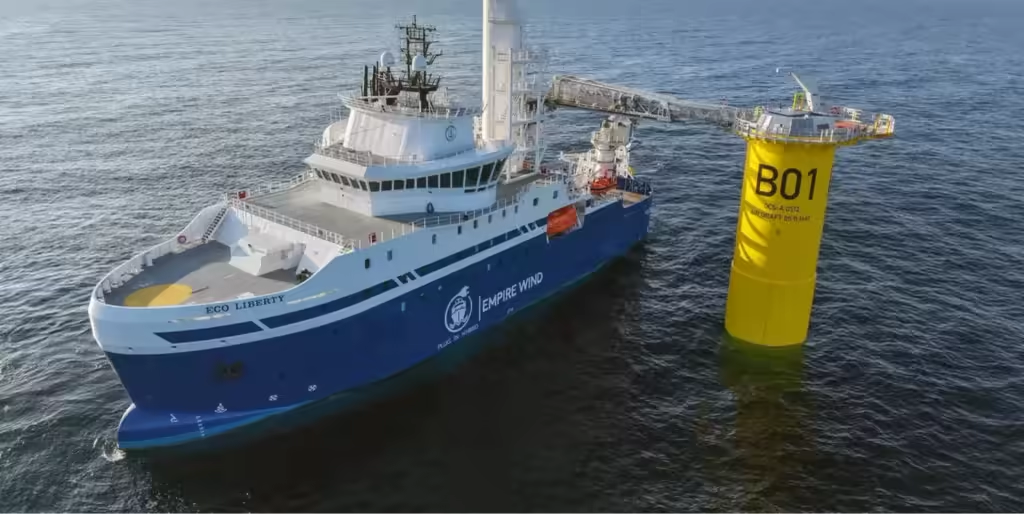
Equinor’s Empire Wind offshore wind project on 15 January joined Revolution Wind in securing a preliminary injunction, reinforcing the emerging legal pattern. Two separate courts had now rejected the administration’s attempt to halt construction based on the same national security argument.
Like for Revolution Wind, it was the second time that Empire Wind needed to fight a stop-work order issued by the Trump administration against the project.
CVOW, Vineyard Wind 1 and Sunrise Wind completing the picture
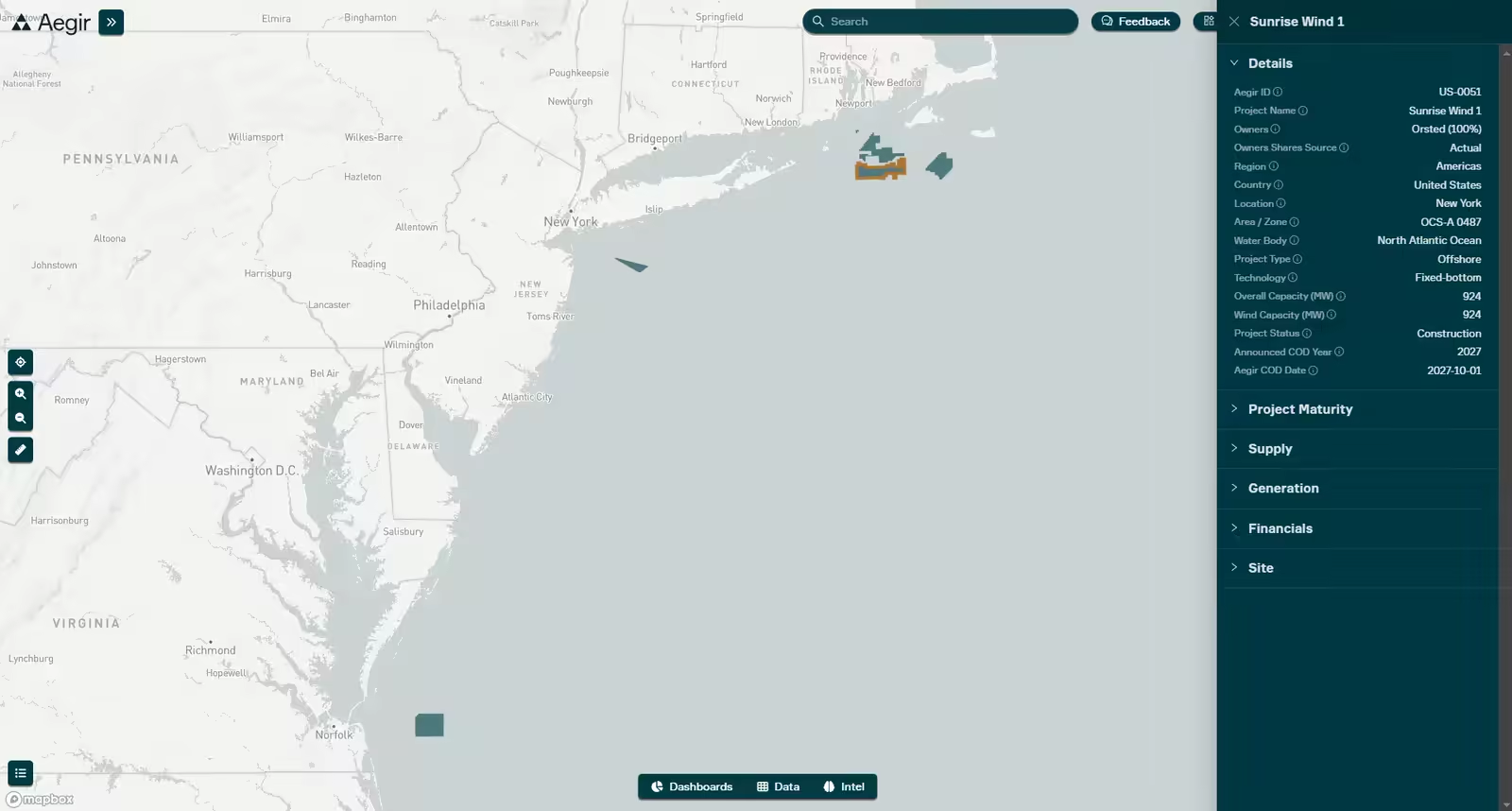
Since then, all three remaining offshore wind projects have been able to secure a win against their stop-work orders in court, with Sunrise Wind being the most recent one with their hearing concluding on 2 February 2026.
While these three projects - Coastal Virginia Offshore Wind (CVOW), Vineyard Wind 1 and Sunrise Wind - attracted less attention than the first two rulings, their wins in court are nonetheless significant as they solidify the precedence that will ensure that any future stop-work orders can be lifted even faster.
Across all five cases, the courts have consistently found that the administration has not met the threshold required to justify such a damaging disruption. The consistency is striking, given that four different judges, in different jurisdictions, have reviewed the cases independently. The judges pointed out that the projects stood to suffer irreparable harm if the stop-work order was not lifted while the underlying cases continue, and that the projects are expected to win on the merits – meaning the judges are quite certain that the projects will prevail in the underlying cases.
The judges also noted the lack of prior notice despite the projects meeting with authorities weekly, and the complete lack of willingness to collaborate with the projects to see if the risks (which still hadn’t been shared with the projects at the point of this blog post) could be mitigated, as well as the unusual length of the stop-work order – 90 days, with an option to extend the period further. All these points, in combination with the administration's frequent outbursts towards offshore wind as a power source, made it clear that the national security concerns were pretextual – mere excuses used to stop projects that the president simply dislikes.
“I don’t think the administration is done bothering these projects, particularly the ones that still have a long road to completion, like Empire Wind and Sunrise Wind. But I believe that with every denied or averted attempt, the next one will look more obviously pretextual.”
Implications for the US offshore wind market
The immediate impact of the stop-work orders has been severe, resulting in large losses for the affected companies and underscoring that the US is currently a market with an unprecedented level of political risk. However, the swift legal responses and wins by these offshore wind projects suggest that long-term damage may be more limited than initially feared.
The disruptions caused by these stop-work orders will likely not delay the projects significantly, as they were lifted so fast. Further, any future stop-work orders the administration might issue are likely to fall even faster in court. While this may not deter Trump from trying again, and while more stop-work orders could still be enormously damaging to projects that are now even more vulnerable to delays as they have already been delayed once (or, in Revolution Wind and Empire Wind’s cases, twice), at least it gives a clear path forward if a project is affected again.
“I maintain the expectation that the five projects will be built, but that it is unlikely other projects move materially forward during the rest of Trump's term. We do however expect that project development in the US will eventually pick back up, as the northeastern US remains a natural offshore wind market, due to high power demand and few options to build out renewable energy sources on land as either population density or grid often constrains that."
Less intense battle for onshore renewables
While the Trump administration has been busy with their persistent efforts to halt offshore wind construction in the US, onshore renewables have had less of a battle to fight. While also not disliked by president Donald Trump, because of shorter project development cycles and construction processes and less need for federal permits, these projects have had an easier time in moving forward. The real challenges for onshore renewables in the US will start once the long-standing Investment Tax Credits and Production Tax Credits for renewable energy projects all run out this summer. Then, only the most economically viable and best placed projects will be able to find customers and come online, and tools like Aegir Insights’ Quant™ model will be crucial to guide investment decisions.
Aegir Insights continues to closely monitor project timelines and political developments across the US offshore wind and onshore renewables market. Clients can reach out to Lead Regional Analyst Signe Sørensen to schedule a session unpacking recent news.
Aegir Newsletter: Stay up-to-date with development in renewable energy and new analysis by Aegir Insights
Delivered straight to your inbox, Aegir Insights' intelligence newsletter will sharpen your market insight with exclusive analysis on key markets, developments, and technologies shaping onshore wind, offshore wind and storage/hybrids.