Are ports the biggest bottleneck for the offshore wind build-out in the North Sea and Baltic?
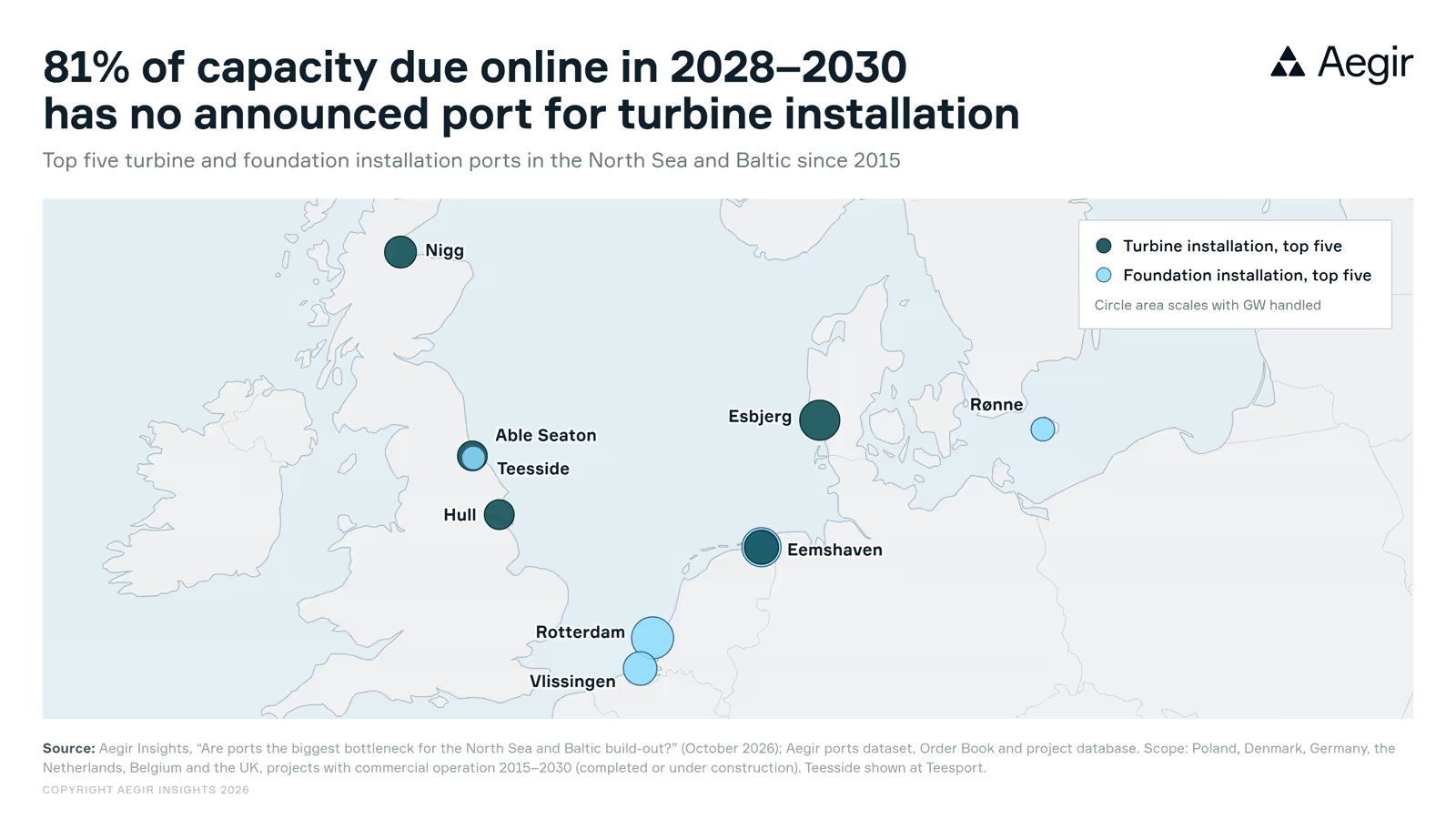
Turbines and foundations for offshore wind projects in Northern Europe are marshalled at two different sets of ports, with both markets concentrated on only a handful of ports.
Turbine ports follow quays and suppliers, as turbines need long heavy-load quays, extensive storage areas and unrestricted access for jack-up vessels. Foundation ports, however, sit close to the fabrication yards.
Port capacity is running short for the next wave of Northern European offshore wind projects. The leading turbine ports are already booked at or above their busiest year, yet 81% of the capacity due online in 2028–2030 has no announced port for turbine installation.
So, will ports become the bottleneck for the next wave of projects?
In Aegir Insights’ new report, we map the turbine and foundation ports behind 96 offshore wind projects in six markets in Northern Europe, rank the leading ports and show who has booked what. We also look at potential congestion, mapping the most likely ports for projects without an announced port and how likely each project is to proceed.
For how turbine, foundation and vessel supply compare with demand, see our analysis of offshore wind supply chain bottlenecks.
Want to know which projects are still without an announced port for turbine installation?
Reach out to us: www.aegirinsights.com/contact
Key questions on offshore wind ports
What does an offshore wind turbine installation port need?
Long heavy-load quays, extensive storage areas and unrestricted access for jack-up vessels. That is why turbine ports follow quays and suppliers.
Why do turbines and foundations use different ports?
Foundation ports sit close to the fabrication yards, while turbines need the quay and storage capacity above. In both markets, the work is concentrated on only a handful of ports.
Which ports lead offshore wind installation in the North Sea and Baltic?
Since 2015, the top five turbine installation ports are Esbjerg, Eemshaven, Nigg, Hull and Able Seaton. The top five foundation ports are Rotterdam, Eemshaven, Vlissingen, Rønne and Teesside.
Will ports become a bottleneck for offshore wind projects due in 2028–2030?
Port capacity is running short. The leading turbine ports are already booked at or above their busiest year, yet 81% of the capacity due online in 2028–2030 has no announced port for turbine installation.